
Why US Export Restrictions on NVIDIA GPUs Are Failing!
The Misguided Focus on Flops
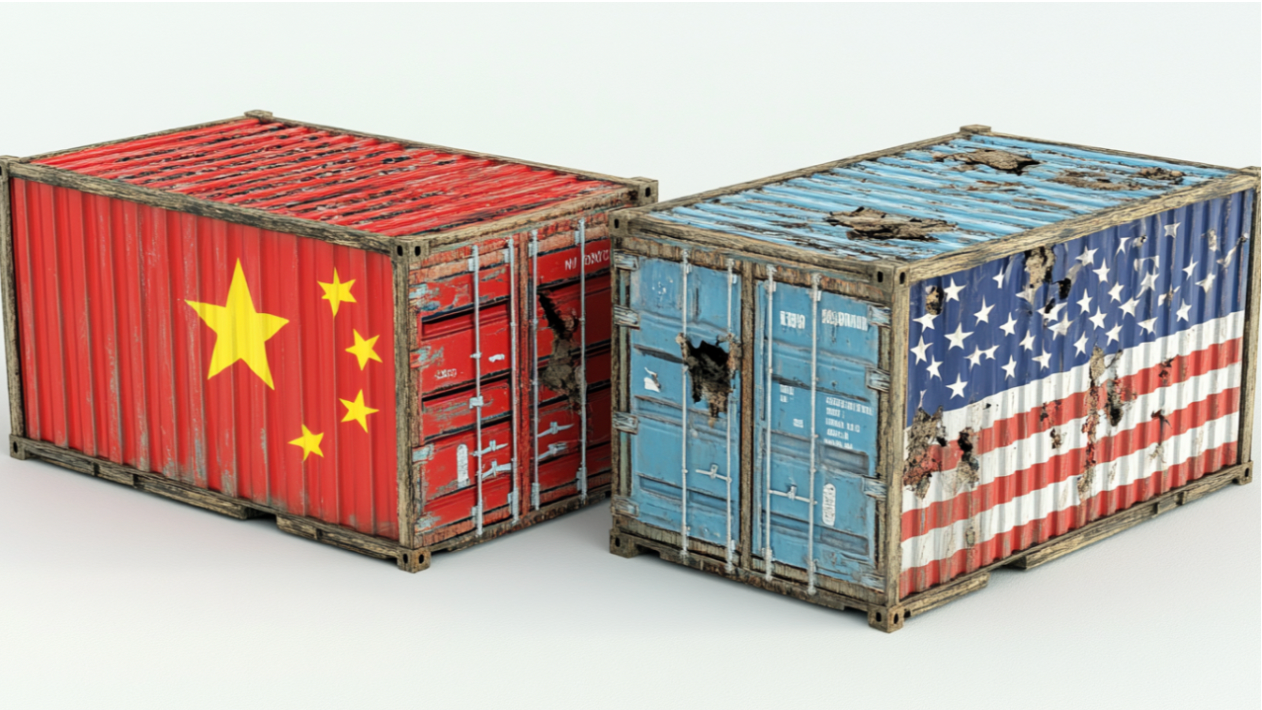
The US imposed export restrictions to prevent China from acquiring high-performance AI chips, aiming to curb advancements in artificial intelligence. These restrictions primarily target compute power, measured in FLOPS (Floating Point Operations Per Second), which has long been used as the benchmark for AI performance. FLOPS is a measure of how many mathematical calculations a processor can perform in one second. It is commonly used to gauge the computational power of GPUs (Graphics Processing Unit). However, this approach overlooks a fundamental shift in AI development, that compute power alone is no longer the defining factor in AI capability!
The real challenge in AI today is not just raw processing power but rather memory efficiency and interconnect bandwidth. Despite US efforts to limit China's access to advanced GPUs, China's AI progress has not slowed, it has simply adapted. By focusing on optimizing memory bandwidth, smarter architectures, and low-level software efficiencies, Chinese AI labs have found ways to work around these restrictions. Had export restrictions worked as intended, the DeepSeek's V3 and R1 models wouldn't be performing on par with GPT-4.
The Shifting AI Bottleneck: Beyond FLOPS
For years, FLOPS was considered the ultimate measure of an AI model's power. Higher FLOPS meant faster computations, which was crucial for pre-training massive AI models like GPT-4. However, modern AI development is shifting toward inference and reasoning, where the primary constraints are memory and data transfer efficiency rather than raw computation.
An example of this shift can be seen in NVIDIA's H20 chip, which was developed as a restricted version of the H100 for the Chinese market. Despite its lower compute power, the H20 outperforms the H100 in memory-heavy reasoning tasks. This demonstrates that AI progress is no longer dictated solely by FLOPS. Instead, memory bandwidth and interconnect speed have become the key determinants of AI efficiency. Recently, it was announced that NVIDIA will develop a cheaper version of its powerful Blackwell GPU for China.
This shift is particularly evident in large language models (LLMs), where the ability to process longer context windows has become essential. Context length is the number of words an AI model can process in a single input. It determines how much past information the model remembers when generating responses. Larger context lengths improve reasoning and coherence but require more memory and computational power, making them a key challenge in AI scaling and efficiency. As context length increases, memory requirements and costs grow quadratically. Inference requires less compute than training but happens continuously at scale.
AI models trained for reasoning require substantial memory to retain and process vast amounts of information over extended sequences. As context lengths grow beyond 7,500 words, memory limitations become a bottleneck, slowing down inference. This impacts enterprise applications including AI Agents for automation workflows, where real-time processing is crucial.
A crucial innovation addressing this challenge is KV Cache (Key-Value Cache), which helps AI models store intermediate computations instead of recalculating them for every new word. While KV Cache reduces processing costs and speeds up inference, it significantly increases memory consumption, requiring efficient management to maintain scalability. In reasoning-intensive AI models like DeepSeek-R1 and OpenAI's advanced LLMs, memory bandwidth has become just as critical, if not more than compute power.
How DeepSeek Overcame U.S. Export Restrictions
DeepSeek's success despite US restrictions offers a compelling case study on how AI companies can thrive without cutting-edge hardware. By developing software and infrastructure optimizations, DeepSeek managed to train high-performing models on restricted GPUs, proving that clever engineering can often compensate for hardware limitations.
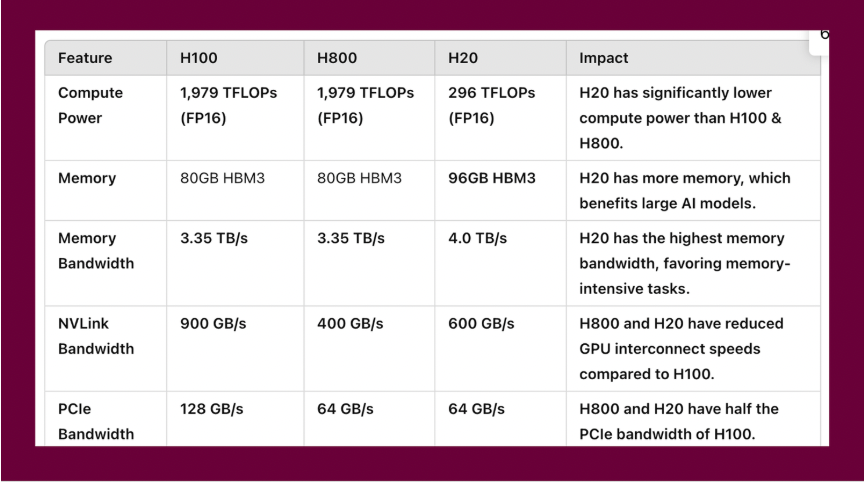
One of DeepSeek's primary strategies was optimizing for NVIDIA's restricted H800 GPUs. The H800 has reduced interconnect speeds. DeepSeek developed custom scheduling algorithms that optimized how GPUs communicated. This allowed them to maximize data transfer efficiency, ensuring that their models ran effectively despite the hardware constraints.
Additionally, DeepSeek scaled up its domestic GPU clusters, leveraging the infrastructure of its parent company, which had already built China's largest GPU cluster in 2021. Estimates suggest that DeepSeek now operates up to 50,000 GPUs, combining NVIDIA's restricted chips with Chinese-manufactured alternatives.
The Future of AI: From Compute Power to Intelligence
The most significant trend in AI today is the shift from brute-force computation to intelligence-driven efficiency. As models become more sophisticated, simply increasing FLOPS is no longer enough. AI performance now depends on how efficiently models process, store, and retrieve information.
Future breakthroughs will come from architectural innovations rather than sheer compute power. Memory-efficient attention mechanisms, optimized inference architectures, and smarter data handling will define the next generation of AI, bringing the field closer to Artificial General Intelligence (AGI).

At the same time, the real bottlenecks in AI development are becoming clearer:
- Memory bandwidth is crucial for large-context reasoning
- GPU High-Speed Interconnects ensure GPUs can share data efficiently
Without these improvements, even the most powerful AI models will struggle with real-time inference.
This shift also has geopolitical implications. While the US restricts FLOPS, China's AI labs are prioritizing memory efficiency and inference scalability, ensuring they remain competitive. NVIDIA's recent cancellation of H20 production suggests they, too, recognize this shift and anticipate further US government restrictions.
The evolution toward memory-optimized AI architectures will particularly benefit applications requiring AI model training on resource-constrained systems, where efficient memory usage becomes critical for practical deployment and scalability.
Environmental and Strategic Implications
The focus on efficiency over raw power also aligns with growing concerns about GPU clusters, and their impact on emissions. More efficient architectures consume less energy, making AI deployment more sustainable and cost-effective. AI vendors continue to focus on increasing model size because of the scaling laws.
From a strategic perspective, companies must recognize that increasing model size does not make LLMs conscious or capable of true reasoning. Moreover, scaling leads to diminishing returns, with ever-larger models yielding smaller performance gains. When selecting an LLM, organizations should focus on practical implementations that deliver real business value rather than chasing model size.
The failure of export restrictions highlights the need for more nuanced approaches to AI governance. Australia, together with a few other countries, has banned DeepSeek for security reasons, but I believe that geopolitical forces are at play. Despite tighter regulation, DeepSeek also opens new possibilities for enterprise AI deployment, enabling companies to achieve advanced AI capabilities without massive infrastructure investments.
Conclusion
The US restrictions on high-performance GPUs were designed to slow China's AI advancements by limiting access to cutting-edge hardware. However, these restrictions failed to address the real bottlenecks in AI progress. As AI moves away from raw computation and toward memory-optimized reasoning, the focus is no longer on who has the most FLOPS, but rather who can run AI models most efficiently at scale.
China's response to these restrictions has not been to halt AI development, it has been to innovate around them. By optimizing memory bandwidth, interconnect speeds, and inference architecture, Chinese AI companies have adapted, proving that the future of AI is not just about compute power, but intelligence itself.
The AI race is no longer just about who can build the biggest models, it's about who can run them smarter, faster, and more efficiently.
Rainmakers SG helps small and medium businesses design safe and scalable Agentic AI systems that provide immediate ROI!