OpenAI Releases Atlas

Google has dominated the internet’s front door for two decades. When we needed information, we "Googled it." That monopoly seemed unshakeable, until November 2022, when OpenAI released ChatGPT and fundamentally changed how we find information.
Now, on October 21, 2025, OpenAI unveiled ChatGPT Atlas, an AI-powered browser that directly challenges Google’s core business. This isn’t just another browser, it’s a reimagining of discovery in an AI-first world. Alphabet’s stock fell 2% to close at $252.25 on the news, reflecting investor concern despite strong fundamentals and a 55% 52-week return. Atlas represents the first credible threat to Google’s core search monopoly in decades.
The Google Era and its Disruption
Traditional SEO optimized for a world where users typed keywords into boxes and clicked blue links. That world is rapidly disappearing. Today's users don't want ten options, they want one answer. They don't want to visit your website, they want their problem solved instantly.
Google built an $80 billion empire on a simple premise: organize the world's information and make it universally accessible. With Chrome's 3 billion users generating billions of daily searches, they didn't just dominate search, they defined it. Every business on Earth either paid Google for visibility or hired armies of SEO specialists to crack their algorithm. Then ChatGPT arrived and made it all irrelevant.
In less than three years, 800 million people weekly stopped searching and started conversing. They no longer wanted ten blue links, they wanted one definitive answer. No browsing. No clicking. No choosing. Just instant, synthesized intelligence.
The numbers tell a brutal story: Gartner predicts traditional search traffic will crater by 50% before 2028. But that's conservative. The real question isn't how much traffic Google will lose, it's whether the concept of 'search traffic' will exist at all.
Atlas: AI-Native Browsing Arrives
Atlas positions ChatGPT as your primary internet interface, not just a tool for finding websites. The key features of Atlas
- Sidebar Assistant – “Ask ChatGPT” button on every page provides real-time context, comparisons, and analysis.
- Browser Memory: Remembers insights from your browsing for personalized help.
- Agent Mode: For paid users: automates multi-step tasks like bookings and research.
- Privacy Controls: Granular, per-site visibility; data not used for training by default.
Enter GEO: Generative Engine Optimization
Generative Engine Optimization (GEO) isn't SEO with a fresh coat of paint. It's a fundamentally different discipline that requires you to unlearn almost everything you know about digital visibility. GEO focuses on getting cited by AI engines (ChatGPT, Claude, Gemini, Perplexity), not just ranked by algorithms. It’s about being the trusted source AI models quote in their answers.
Here's the critical distinction most people miss:
- SEO fought for rankings in a list while GEO fights for inclusion in a synthesized response.
- SEO optimized for keywords while GEO optimizes for conceptual relevance.
- SEO measured success by traffic while GEO measures success by attribution.
Think about it: When was the last time you scrolled past the AI-generated answer to click a traditional search result? Your users aren't doing it either.
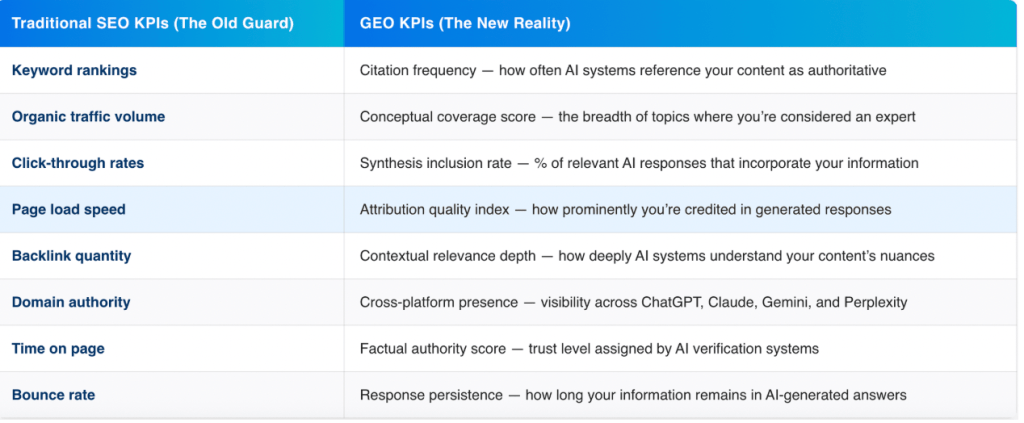
This isn't a small adjustment to your existing framework, it's a complete overhaul of how you measure digital success.
Companies spending millions on traditional SEO are watching their traffic evaporate while their competitors, who've never heard of meta descriptions, dominate AI responses. Why? Because they accidentally optimized for what matters now: being undeniably authoritative, contextually comprehensive, and structured for machine understanding.
Your beautifully crafted 2,000-word blog posts, optimized for featured snippets? They're being reduced to a single sentence in an AI response, if they're lucky enough to be included at all.
The Strategic Pivot Most Will Miss
The winners in the GEO era won't be those with the most backlinks or the fastest websites. They'll be the ones who understand three fundamental truths:
- AI systems don't browse, they comprehend. Your content needs to be structured for instant understanding, not gradual discovery.
- Authority isn't about links anymore, it's about factual density. One comprehensively accurate page beats fifty keyword-stuffed articles.
- The new currency isn't traffic, it's trust. Being the source AI systems default to matters more than ranking #1 for a thousand keywords.
The Path Forward: Adaptation or Irrelevance
GEO isn't coming, it's here. Every day you optimize for Google's past instead of AI's present is a day your competitors pull further ahead. The transformation requires:
- Restructuring content for machine parsing, not human scanning
- Building topical authority clusters, not keyword pages
- Creating definitive resources, not content volume
- Establishing factual verification trails, not just citations
- Developing API-ready content structures, not just HTML
The Bottom Line
SEO isn't dead, it's been absorbed into something larger. Like print advertising didn't disappear but became one small component of marketing, SEO is now just one element of GEO. The question isn't whether you'll adapt. It's whether you'll adapt fast enough to matter.
The search box is becoming a conversation. The SERP is becoming a synthesis. The website visit is becoming an API call.
Welcome to the post-SEO world. The rules you mastered no longer apply!
The future belongs to those who optimize for intelligence, not algorithms. The shift from SEO to GEO isn't just a tactical change, it's a complete reimagining of digital presence. Start measuring what matters now, not what mattered yesterday.