Retrieval-Augmented Generation (RAG) Explained
LLMs have been trained on a massive amount of public data, but we often forget that 95% of all data in this world is private.
Large language models (LLMs) like GPT-4, GPT-4o, Claude 4, DeepSeek R1/V3, LLaMA 2, and Mistral have captured the attention of enterprises looking to leverage Generative AI to streamline operations, improve decision-making, and enhance customer experience. However, these LLMs come with limitations: they are only as knowledgeable as the data they were trained on, often generating "hallucinations" when specific data cannot be found. Retrieval-Augmented Generation (RAG) offers a solution to this problem, at least partly, by enhancing language models with real-time information retrieval capabilities from private data sources.
In this blog, we break down what RAG is, why it's valuable for enterprises, and where it's used. We also compare RAG to ChatGPT Enterprise, explain why companies ban ChatGPT at work, and explore RAG deployment options, cloud, on-prem, and hybrid. The content is structured in simple Q&A-style snippets to make complex topics easy to follow.
RAG is a common starting point for companies exploring AI, and many are actively testing it. But large-scale production deployments are still rare, and the Return on Investment (ROI) remains unclear. Most companies limit RAG to internal use due to risks like hallucinations, copyright, and privacy concerns.
What is RAG?
In its simplest form, RAG is an AI architecture that augments traditional LLMs by integrating a retrieval system. Let's take a look how we can use RAG for sales automation. Anna is a sales assistant and is tasked with providing real-time sales information.
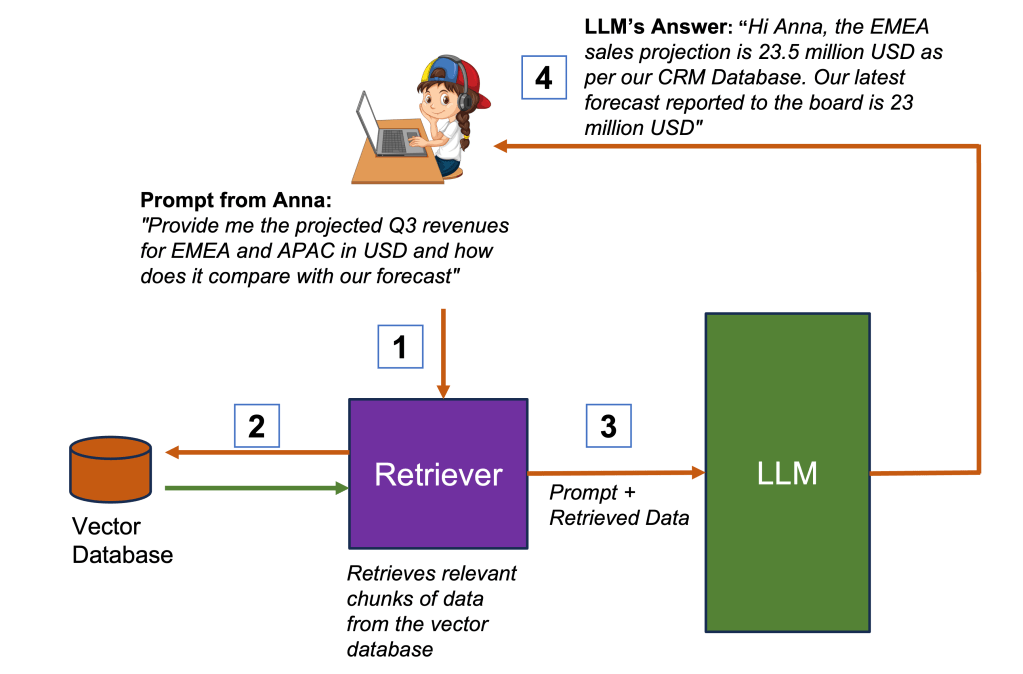
When asked a question (prompt), the RAG system retrieves relevant chunks of information from a company database, called vector database. The retrieved information, combined with the original prompt will be fed to the LLM as the new, augmented prompt. The LLM subsequently generates an answer based on the augmented prompt. Because the information is extracted from the company's private database, the risk of incorrect or fabricated information (hallucinations) is sharply reduced. In addition, the information is available in real-time, as soon as it exists in the vector database. If we would run the same prompt in a week, the answer may be different as the forecast may have changed.
Traditional LLMs risk to hallucinate mainly because of two reasons:
- private, company information is not public and as a consequence the LLM was not trained on it
- the information is too recent, while LLMs have a training cut-off date
Keyword Search vs. RAG (Semantic Search)
One key distinction with RAG is that it utilizes semantic search rather than traditional keyword search. In keyword search, queries/prompts are matched based on exact words or phrases, limiting the retrieval to documents containing those specific terms. This method often struggles with nuances in language, and a document could be missed if it doesn't contain the exact wording used in the query/prompt, even if it's contextually relevant.
RAG, however, employs semantic search, which focuses on the meaning of the prompt rather than the exact words in the prompt. RAG retrieves relevant passages from a document, even if the exact terms aren't present in that document. This allows RAG to deliver more accurate, contextually relevant results, providing a higher level of precision and understanding, especially in complex or dynamic fields like healthcare or legal research.
What makes RAG so appealing to companies?
For industries like healthcare, finance, telecommunications, and law, where regulations and standards constantly change, real-time accuracy is crucial. RAG provides enterprises with up-to-date, dynamic information, minimizing the risks of outdated or incorrect insights. Companies managing large proprietary datasets or operating in highly regulated environments, such as finance or healthcare, benefit significantly from on-premise or hybrid RAG deployments.
Key Benefits of RAG for Enterprises:
- Real-Time Information: RAG accesses the latest, most relevant data, enhancing decision-making and productivity.
- Accuracy: By reducing hallucinations and grounding content in factual data, RAG minimizes misinformation. The risk of hallucinations however, is lower but not zero.
- Productivity Boost: RAG automates tasks like reporting, email responding, and document summarization, improving efficiency. Integration with automation platforms like n8n enables seamless workflow automation across business processes.
- Semantic Search: RAG provides precise, contextually relevant results, improving understanding and accuracy.
- Security: On-premises RAG ensures that proprietary data stays within the company's firewall, enhancing data security and compliance with data privacy regulations.
Three Potential Use Cases for RAG
In practice, RAG will be a part of a broader automated workflow. Platforms like n8n and Make.com simplify the integration of RAG, enabling access to the company’s private vector database within the process. RAG will be a component of an Agentic AI system and the AI Agents sees RAG as a tool. Here are 3 use cases
- Customer Support: RAG can enhance AI Agents and chatbots to provide accurate, up-to-date answers to customer queries by retrieving information from product databases or FAQs. However, a human in the loop (HITL) check is required in order to control what goes out to customers. The HITL process obviously reduces some of the productivity that was gained through the deployment of RAG.
- Regulatory Compliance: Financial or legal firms can use RAG to stay compliant with changing laws and regulations by retrieving the latest updates in real-time. Applying the retrieval process to legal databases such as NexisLexis and Westlaw has a significant impact on productivity and ensures compliance accuracy.
- Medical Diagnosis Support: Healthcare professionals can use RAG to access the latest research and clinical guidelines, ensuring treatments are based on current best practices and the most recent medical literature.
RAG enables AI systems to deliver timely, accurate, and personalized responses across the customer journey. This integration helps businesses reduce manual workload, improve engagement, and drive ROI through automation backed by real-time data retrieval.
The combination of RAG with modern reasoning models like DeepSeek R1 or OpenAI's o1 series creates particularly powerful solutions for complex business scenarios requiring both factual accuracy and sophisticated reasoning capabilities.
Need help deploying RAG in your company? Rainmakers SG offers end-to-end RAG solutions as a managed service (RAGaaS). Implementation is extremely fast and tailored to your specific business requirements.