AI Agents Revolutionizing Search Engine Usage
Tools like ChatGPT function as powerful AI Agents, capable of understanding context, browsing the web when needed and generating content in ways that traditional search engines cannot.
Before 2023, no one would question Google's dominance as the go-to search tool. Its dominance in the search market consistently made Google one of the most valuable companies in the world. In Novembe r 2022, OpenAI introduced ChatGPT to the world and this took everyone by surprise, including Google. About two years later, many of us use ChatGPT on a daily basis for a variety of tasks, including search. With my own reduced reliance on Google as a search engine, I became curious if my professional network was experiencing the same shift. I launched a LinkedIn poll asking, 'Before the launch of ChatGPT, you may have relied 100% on Google for internet searches. What percentage is that today?'
About 50 people responded to the poll and this blog will discuss the results and explore the potential reasons for this shift, if any.
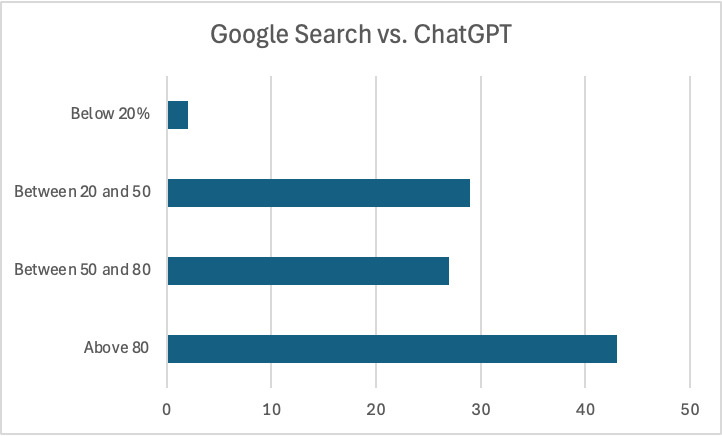
While AI tools like ChatGPT are making significant strides, the poll results indicate that Google's dominance among professionals remains solid, for now. The results surprised me, particularly because my own reliance on Google has dropped below 20%, as has my family's. So, why do professionals still depend so heavily on Google?
Familiarity & Trust
People have been using Google for decades, and it has consistently provided reliable, accurate, and fast results. The transition to AI tools like ChatGPT involves learning a new way to interact with search, via prompts. Trust plays a big role and everybody is aware that ChatGPT may hallucinate and produce incorrect answers.
Lack of Prompting Skills
The continued use of Google could be partly linked to a lack of effective prompting skills. There is no user manual for ChatGPT and many users are still accustomed to keyword-based searches and may not be familiar with prompt engineering. I also noticed that a better understanding of Generative AI fundamentals enhances a user's prompting skills. My advice to any professional is to refine your prompting skills because the benefits are significant and immediate: better prompts lead to better answers and a significant increase in productivity. Organizations investing in AI training can help their teams develop these critical skills for both search and broader business applications. Keep in mind that practice makes perfect!
Unawareness of ChatGPT's full set of features
Users may be unaware of ChatGPT's full range of features, especially its vision and voice capabilities when generating new content. Just a few months ago, I was challenged to solve 5 complex physics problems, each more than a page long. I was able to get a score of 80% on average, with a simple prompt. This demonstrates the power of short, but well-crafted prompts even in contexts requiring complex reasoning. I heavily relied on ChatGPT's vision capabilities.
Modern AI tools have evolved significantly beyond simple text generation, offering capabilities that many professionals haven't fully explored or integrated into their workflows.
Semantic Search (ChatGPT) vs. Keyword Search (Google Search)
The choice between Google and ChatGPT depends on the nature of the search. Let us take a look at the following comparison. When examining these differences, you get a sense of how powerful semantic search really is, compared to keyword search.

Google search remains excellent for finding specific, real-time, and factual information. Google matches exact terms to its massive database of indexed content, making it highly efficient for users seeking fast and precise answers or concrete sources. This is particularly important for SEO professionals and businesses that need to understand current search rankings, web presence, and competitive analysis. While AI tools have improved significantly in providing current information, Google's real-time indexing remains a key advantage.
Semantic search, as used by tools like ChatGPT, moves beyond simple keywords to grasp the meaning and intent behind queries. This makes ChatGPT well-suited for complex, conversational, or abstract searches, like offering advice, solving problems, or giving in-depth explanations.

Unlike Google, which resets the context with each search, ChatGPT can maintain and understand the context across multiple conversational interactions. A Google search output often presents data that requires additional analysis or synthesis. Professionals however, prefer actionable insights rather than sifting through numerous web pages. Beyond finding information, ChatGPT can generate new content, including code, making it more versatile than keyword-based search engines. This capability is particularly valuable for sales and marketing automation workflows, where personalized content generation and strategic insights are crucial for business operations
Real-Time Information and Current Capabilities
One of the reasons professionals continue to rely on Google is its ability to deliver real-time information. Whether you're looking for breaking news, live sports updates, stock prices, or the weather, Google provides instant results.
However, the AI landscape has evolved dramatically since 2024. Current language models have much more recent training data and many now include real-time web browsing capabilities as standard features.
This evolution has been accelerated by the integration of AI Agents with live data sources, real-time APIs, and current web content, making them increasingly competitive with traditional search for time-sensitive information.
Google I/O 2025
The prediction about 2025 being a turning point for Google's strategy has proven at least to be partially accurate. We have witnessed significant developments in the search landscape:
- Google has accelerated its AI integration across all products, including search
- Competition from AI-powered search alternatives has intensified
- User behavior continues to shift toward conversational and semantic search patterns
- The boundaries between search engines and AI assistants continue to blur
The competitive dynamics have indeed shifted, though Google's market position remains strong due to its vast infrastructure, real-time indexing capabilities, and established user base.
Strategic Considerations
The shift toward AI-powered search also requires understanding AI's weaknesses when it comes to reasoning and acting consciously rather than treating these tools as infallible sources of information.
Organizations adopting AI-powered search must choose models that align with their needs, whether using options like DeepSeek or proprietary models, each with trade-offs in performance, cost, and compliance.
Integrating keyword search with RAG systems further enhances access to both internal knowledge and external data sources.
The Impact on Coincidence and Discovery
As AI Agents become more sophisticated at predicting what we want to find, we risk losing the serendipitous discoveries that come from unexpected search results. This connects to broader questions about whether AI optimization eliminates beneficial randomness, in our information discovery processes.
Conclusion
While the rise of AI-powered tools like ChatGPT is reshaping the search landscape, the future holds a hybrid model where both Google Search and AI Agents coexist, each serving different use cases and user preferences.
Despite ChatGPT's popularity, the poll shows that many professionals still rely on Google because of familiarity, trust, unawareness of AI agents' full capabilities, and lack of advanced prompting skills.
I believe that the use of Google Search will continue to decline for certain types of queries, mainly because of the massive benefits that semantic search has to offer. OpenAI's first-mover advantage with ChatGPT allowed it to capture a significant portion of the market. ChatGPT became a household name, and through continuous interaction with a large user base, AI companies are rapidly improving their models' performance.
The search landscape has become more nuanced and competitive. Rather than a simple replacement scenario, we're seeing the emergence of specialized tools for different search contexts - from real-time factual queries to complex analytical tasks requiring reasoning and content generation.
The transformation is ongoing, and professionals who develop skills in both traditional search optimization and AI-powered semantic search will be best positioned to leverage the evolving information landscape effectively.
Rainmakers SG helps small and medium businesses design safe and scalable Agentic AI systems that provide immediate ROI!