AI Agents: Revolutionizing Information Processing

Traditional Generative AI models face three key challenges.
- Large language models (LLMs) like GPT-4 are pre-trained, meaning their knowledge and generating ability is constrained by the data they were trained on. This limitation can make it challenging to generate accurate, context-specific responses, particularly with rapidly changing information.
- Most commercial LLMs, are difficult and costly to fine-tune and adapt
- To reduce the risk of hallucinations, many companies are turning to Retrieval-Augmented Generation (RAG). RAG integrates real-time information retrieval into responses, ensuring grounded outputs supported by up-to-date and controlled data sources.
Agentic AI refers to multi-Agent, intelligent systems that act autonomously and independently with minimal human oversight. These agents can reason, plan, reflect and store information to adapt dynamically to changing situations. Agentic AI is set to disrupt and eventually replace traditional SaaS.
Agents are central to reinforcement learning systems, where they learn by interacting with their environment. Through this process, positive outcomes are rewarded to reinforce good decisions, while negative outcomes are penalized to discourage similar actions in the future. However, this trial-and-error approach can be costly and risky, especially in the context of autonomous driving Agents. One option is to expose the Agent to simulated experiences in an offline setting, allowing the agent to learn and refine their behaviour before being deployed on our roads.
The autonomy feature, however is an issue for the majority of enterprises, especially the ones that are regulated such as banks. In an enterprise setting predictability trumps autonomy. Current and upcoming Agentic AI applications will therefore put limits on what an Agent can decide or do. That is why I would categorize Agentic AI applications as RPA+ (Robotic Process Automation), at least for the near future. Agentic AI is also poised to revolutionize sales and marketing automation, helping enterprises reduce friction in the customer journey and personalize outreach at scale. This development underscores the growing role of enterprise AI in driving business efficiency and competitive advantage.
From RAG to Agentic AI
In Generative AI, users interact with LLMs using simple prompts, for example, requesting a Q3 sales forecast report. However, ChatGPT can't provide a useful answer in this case because its training data stops at a fixed cutoff date and it doesn't have access to private company data. Without this context, the model is likely to hallucinate and generate inaccurate information.
As a result, companies are exploring RAG systems, essentially semantic search engines for the enterprise. Let's develop a RAG scenario for sales operations and gradually evolve it into an Agentic AI system.
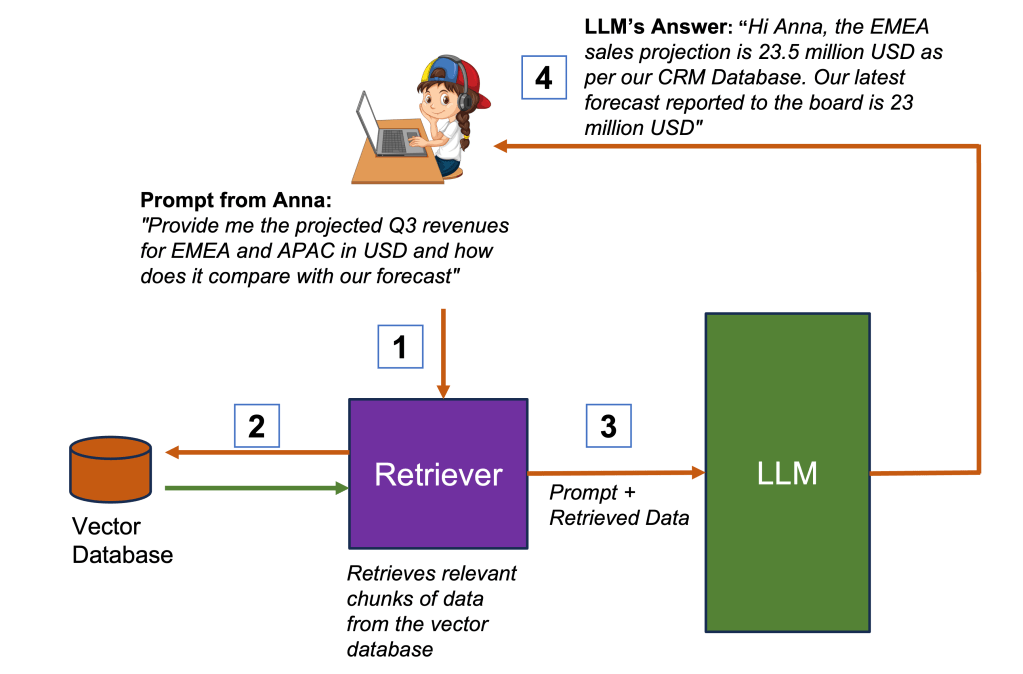
In the RAG scenario, Anna initiates a prompt (1), which retrieves relevant chunks of information from a vector database (2). The retrieved data is combined with Anna's original prompt, forming a new, enriched prompt that is fed into the LLM (3). The LLM then generates a response based on this augmented input (4). The RAG system reduces the risk of hallucinations as the information source is private.
Now, let's transform the RAG system into a modular Agentic AI system by elevating the LLM to the role of an Agent, responsible for autonomously orchestrating the entire system logic. Positioned at the core of the problem-solving process, the LLM agent will not only generate responses but also devise plans and reason through each step along the way. Agentic AI is becoming increasingly feasible as LLMs display more advanced reasoning abilities.
Back to our workflow example. Anna drafts the following prompt: "Generate a PDF report on Q3 revenue projections for EMEA and APAC in USD and CNY. Compare with forecasts, highlight gaps, suggest actions, translate to Chinese, and send to Michael Yu."
She submits his query to the LLM Agent #1. The Agent then initiates the planning phase (2), breaking the task up into smaller subtasks and identifying the appropriate tools to execute on them (3). Tools are any piece of external software that you want to give your Agent access to. The LLM Agent can decide which tool to call at any given time in order to solve the problem at hand, effectively and efficiently. Tools may include Internet Search (for real-time FX rates USD/CNY), Retrieval Tools (RAG), Calculator, PDF Convertor and Microsoft Outlook to prepare the draft email to Michael. If specific tools are unavailable to the Agent, it engages other agents like Agent #2 (3) to complete the translation task (English to Chinese).
The autonomous execution of the subtasks via tools is mature technology and has recently been standardized using MCP or Model Context Protocol.
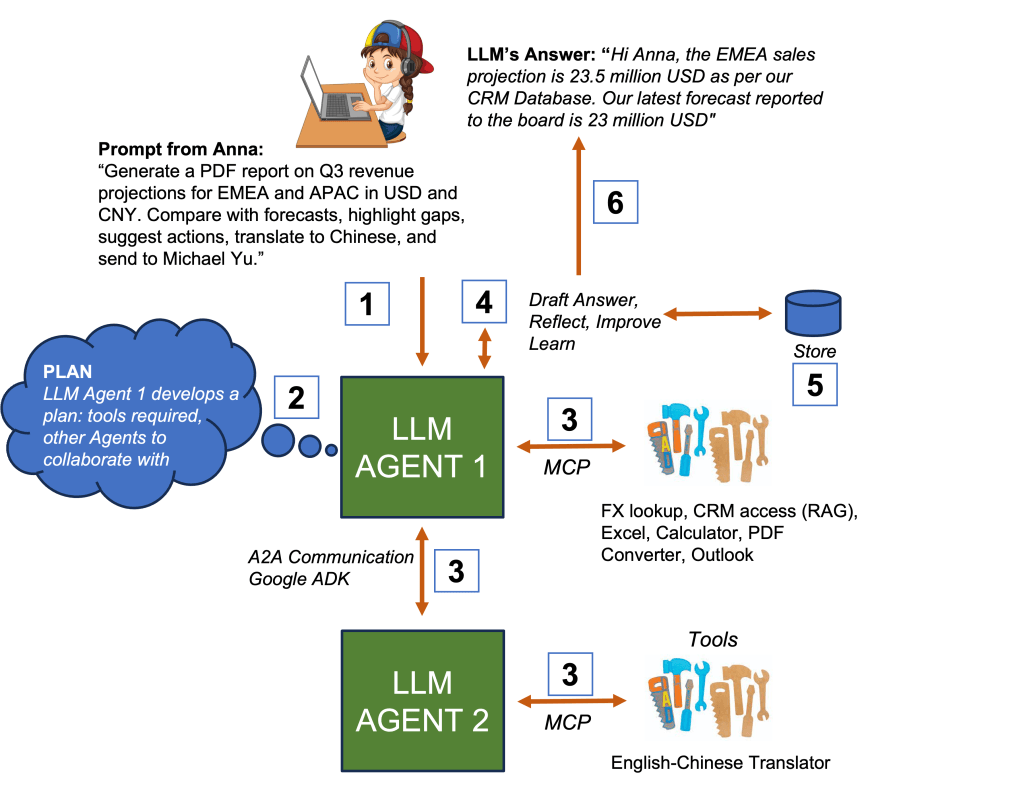
The Agent will reflect on the draft answer and will iteratively review, refine and factcheck it (4). The Agent has the ability to access memory (5). For example, Anna's interaction log details will be stored for future use.
Only when the quality of the answer is satisfactory, the agent will send the answer to Anna (6): "Hi Anna, the EMEA sales projection is 23.5 million USD as per our CRM Database. Our latest forecast reported to the board is 23 million USD"
A simple two-agent workflow could learn from experience and eventually handle complex tasks with minimal human input, assuming patience and tolerance for early-stage failures.
In practice, however, planning and inter-agent communication remain a challenge. For now, agent-to-agent (A2A) interaction isn't a priority, as most companies will be focused on overcoming the challenges of single-agent systems. Task sequences can be hardcoded to address current planning gaps.
Agentic AI & The Enterprise
Experts predict that enterprises will adopt Agentic AI at scale within 2–3 years as the technology matures and seamlessly integrates with existing tools. However, a significant challenge lies in developing agents that can execute long task sequences with minimal error.
Agentic AI will play a crucial role in areas requiring decision-making and dynamic task management. It should be no surprise that tech giants like OpenAI, Meta, Google, Salesforce, Microsoft, Apple and NVIDIA are driving Agentic AI's advancements. Early implementations are expected to streamline back-office operations and customer service, gradually expanding to more complex workflows. Organizations investing in AI Training will be better positioned to leverage these capabilities effectively. Relevant use cases include:
- Customer Service Automation: Agents handle 24/7 support, manage inquiries, and autonomously apply discounts.
- Supply Chain Optimization: Agents monitor inventory levels and coordinate logistics for efficient distribution.
- Healthcare Management: Agents assist with patient data management, appointment scheduling, and health tracking via wearables.
- Software Development: Agents collaborate in real-time to write, review, and optimize code through AI Content Generation and automated testing processes.
Agentic AI will further automate tasks beyond what Generative AI can achieve, posing a risk to certain job roles such as Customer Service and Technical Support Agents, Data Entry Clerks, Paralegal and (Legal) Assistants in general. On the flipside, Agentic AI will also create opportunities by augmenting roles such as engineers, lawyers and analysts.
NVIDIA's CEO Jensen Huang envisions a future where millions of AI agents work together using reasoning, memory, and tools. These agents will autonomously solve problems and even create new tools, promising to transform enterprise workflows, boost productivity, and fuel innovation.
In my opinion, though, the majority of companies are not ready to deploy autonomous Agents, and will not be for a while, because of the risks.
Agentic AI Tools
Agentic AI is evolving rapidly, with a new wave of tools focused on automating multi-step tasks, integrating with enterprise systems, and enabling dynamic workflows.
CrewAI and LangGraph have emerged as powerful orchestration frameworks, enabling coordination between multiple AI agents and tools. Meanwhile, LangChain and n8n are laying the groundwork for modular, extensible agent workflows. In particular, n8n, offers a flexible low-code automation platform with native AI integrations, allowing users to build custom workflows that connect LLMs with APIs, databases, and third-party services.
As tools mature, Agentic AI is set to transform enterprise operations, improve decision-making, and drive major gains in efficiency through continuous learning and system integration. AI consulting firms are increasingly helping businesses navigate the implementation of these sophisticated systems to maximize ROI and minimize operational disruption.
What is the difference between Agentic AI, AGI and RPA?
Agentic AI should not be confused with Artificial General Intelligence (AGI). Artificial General Intelligence (AGI). AGI refers to a hypothetical system with human-like cognitive abilities, capable of performing any intellectual task a human can. By contrast, Agentic AI focuses on specialized, task-oriented agents that collaborate, and adapt within specific contexts. While both concepts aim to achieve autonomous behaviour, Agentic AI remains within the realm of narrow AI with defined roles.
While RPA (Robotic Process Automation) focuses on automating repetitive tasks using predefined rules, agentic AI offers more flexibility. Agents can adjust workflows based on real-time input and collaborate with other agents to solve complex problems, going beyond the static nature of RPA. UiPath and similar platforms are beginning to integrate Agentic AI features to enable dynamic automation, allowing for more adaptive enterprise operations.
Successful LLM deployment extends beyond model selection to include proper training and governance. Organizations must address and ensure teams understand both the capabilities and limitations of AI systems.
Conclusion
Agentic AI represents the next evolution of AI in the enterprise, offering the potential to revolutionize workflows with dynamic, adaptive, and collaborative agents. While planning and agent-2-agent collaboration remain challenging, experts project that we will see large deployments of Agentic AI before 2030. Enterprises that embrace agentic AI will unlock new efficiencies, improve productivity, and position themselves for success in an increasingly automated world.
Rainmakers SG helps small and medium businesses design safe and scalable Agentic AI systems that provide immediate ROI!